ICME 2026 APS Challenge
Challenge Description
Understanding ancient diets is essential for reconstructing subsistence strategies and human–environment interactions. Plant seeds are key archaeobotanical evidence, yet their identification still relies on time-consuming expert analysis. Existing datasets mainly contain well-preserved samples and fail to reflect real archaeological conditions.
To address this gap, the APS Challenge extends the original APS dataset by incorporating severely damaged and carbonized seed images. Participants are invited to develop robust fine-grained classification models that handle high inter-class similarity and large intra-class variation under realistic conditions.
Register for the Challenge: To streamline the participation process, each team only needs to register one Codabench account during the competition. The complete list of team members and their affiliations must be declared when submitting the technical report.
Important note: The email address used to register the Codabench account must belong to one of the team members.
📅 Important Dates (All deadlines are at 23:59, UTC)
- Registration Open & Training/Validation Data Release 2026-02-10
- Testing Data Release 2026-04-01
- Result Submission Deadline 2026-04-10
- Model Code & Weight File Submission Deadline 2026-04-12
- Final Decisions Announcement 2026-04-15
- Challenge Technical Report Submission Deadline 2026-04-20
Dataset
The APS Challenge dataset extends the original APS (Ancient Plant Seeds) dataset with severely damaged and carbonized seed images, providing a more realistic representation of archaeological conditions. The dataset includes various seed categories with fine-grained annotations to facilitate the development of robust classification models.
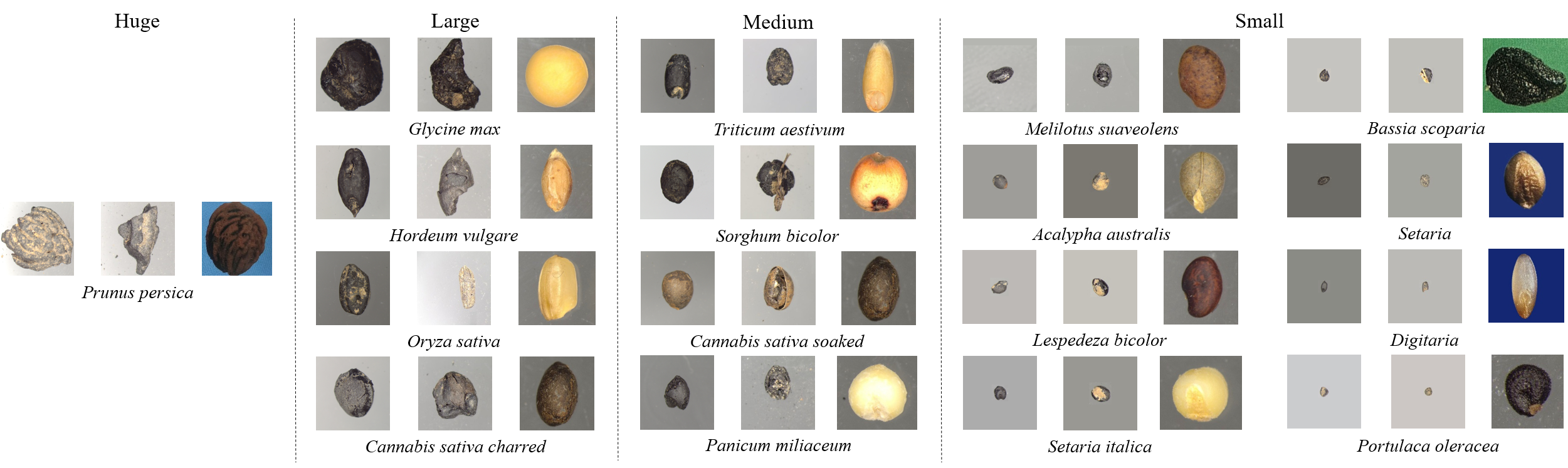
Figure 1: Comparison of the size and damage of ancient plant seeds and the condition of modern seeds. We divide the seeds into four sizes, where each has three columns of seed images. The first column shows the true seed size under 1.6× magnification, the second column shows seeds with pronounced differences caused by uncontrollable factors, and the third column shows the corresponding modern seeds.
📁 Dataset Structure
Train: 6000
Validation: 500
Test: 2500
Rules
📝 Submission Guidelines
Participants are required to submit prediction results through the competition platform (Codabench).
Submissions should be provided as a result.txt file, where each line follows the format:
image name + predicted label.
Challenge Phases
Phase I: Participants submit the validation set prediction results on the evaluation website to get feedback on the evaluation metrics.
Phase II: Participants submit the prediction results of the test set on the evaluation website to obtain real-time feedback of the evaluation metrics and real-time ranking of the leaderboard.
Each team is limited to a maximum of five submissions per day.
📊 Evaluation Criteria
As this is a multi-class classification task, performance will be evaluated using Accuracy, Precision (macro), Recall (macro), and F1-score (macro). Accuracy and F1-score (macro) will serve as the primary ranking metric.
Evaluation Metrics
Where: TP = True Positive, TN = True Negative, FP = False Positive, FN = False Negative
ℹ️ Notes
- The participates can form their own teams from different organizations and the number of participants is not limited. But one person can only join one team.
- The participates are NOT allowed to use external data for either training or validation.
- Participants were not allowed to use additional information manually labeled on the training or validation datasets to identify the target label of the challenge.
- The provided dataset can only be used for academic purposes. By using this dataset and related software, you agree to cite our dataset and baseline paper.
- The top three participants will receive a certificate based on the ranking of Testing Data as the final list.
- Contestants were allowed to use methods other than the baseline model.
Baseline Method (APSNet)
We provide a baseline model, APSNet, while allowing participants to adopt any methods beyond the baseline. Our previous work, which has been publicly released on arXiv, is adopted as the baseline method for this challenge and also serves as the source of the APS dataset. The proposed APSNet demonstrates competitive performance on fine-grained ancient plant seed classification. The source code of the baseline method is publicly available at Github. Participants are encouraged to cite our baseline paper if it is relevant to their research.
⭐ BibTeX
@article{xing2025towards,
title={Towards Ancient Plant Seed Classification: A Benchmark Dataset and Baseline Model},
author={Xing, Rui and Cong, Runmin and Wu, Yingying and Wang, Can and Tang, Zhongming and Wang, Fen and Wu, Hao and Kwong, Sam},
journal={arXiv preprint arXiv:2512.18247},
year={2025}
}
Organizers

🚩 Runmin Cong
Professor, Shandong University
Director of MVP Group

🚩 Can Wang
Professor, Shandong University
Member of Archaeological Society of China

👥 Wei Zhang
Professor, Shandong University
Vice Dean of School of Control Science and Engineering

👥 Fen Wang
Professor, Shandong University
Dean of School of Archaeology

👥 Sam Kwong
Professor and Vice President, Lingnan University
🚀 Join the Challenge!
Advance the state-of-the-art in archaeological artifact identification and contribute to the preservation of human heritage.
📧 Contact Us
For questions about the challenge, please contact the organizers at: apschallenge@163.com